Amazigh culture in the High Atlas: language, Tifinagh and Yennayer
The language you hear in Imlil, the letters on the signs, and the symbols you will see on rugs, flags and on this site.
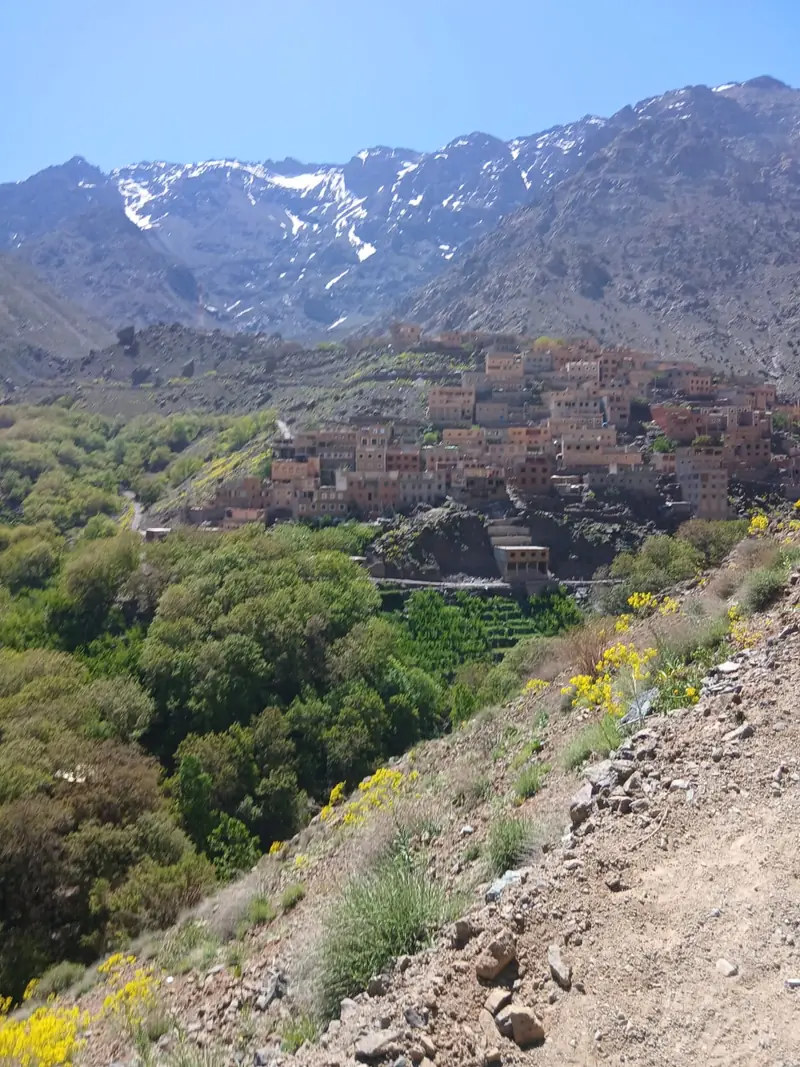
Imlil is an Amazigh village. The Amazigh people, often called Berbers in English, call themselves Imazighen (one person is an Amazigh). The word is often translated as “free” or “noble” people, though scholars still argue about that meaning.
The language you hear in Imlil
In the western High Atlas, the Anti-Atlas and the Souss valley, people speak Tashelhit, which speakers call Taclḥiyt. In the 2024 Moroccan census about 14.2% of the population, roughly 5.2 million people, spoke it. Since the 2011 constitution, Tamazight has been an official language of Morocco alongside Arabic.
Tifinagh, the Amazigh alphabet
Tifinagh descends from the ancient Libyco-Berber alphabet. In 2003 Morocco adopted a modern form, Neo-Tifinagh, standardised by the Royal Institute of Amazigh Culture (IRCAM). Today you see it mostly on public signs.
The name of our village is written ⵉⵎⵍⵉⵍ in Tifinagh: i, m, l, i, l. You can see it at the top of our home page.
The yaz
The letter ⵣ, called yaz, is the Tifinagh z, the z at the root of the word Amazigh. It stands in red at the centre of the Amazigh flag, designed in 1970, where it is said to represent resistance and the free people of the Imazighen. The flag’s blue stands for the sea, green for the mountains and yellow for the desert.
Yennayer, the Amazigh new year
Yennayer, the Amazigh new year, falls in mid-January. In May 2023 King Mohammed VI made it an official paid public holiday in Morocco, and it was celebrated as one for the first time on 14 January 2024.
The patterns on the rugs
Zigzags, lozenges, chevrons and crosses appear again and again in Amazigh rugs and in the old facial tattoos of Amazigh women. Their meanings differ from tribe to tribe and from region to region. The lozenge is often linked with women and fertility, and the zigzag with water and mountain streams. Much of what is written about these meanings online is guesswork, so we treat them as a living pattern rather than a fixed code.
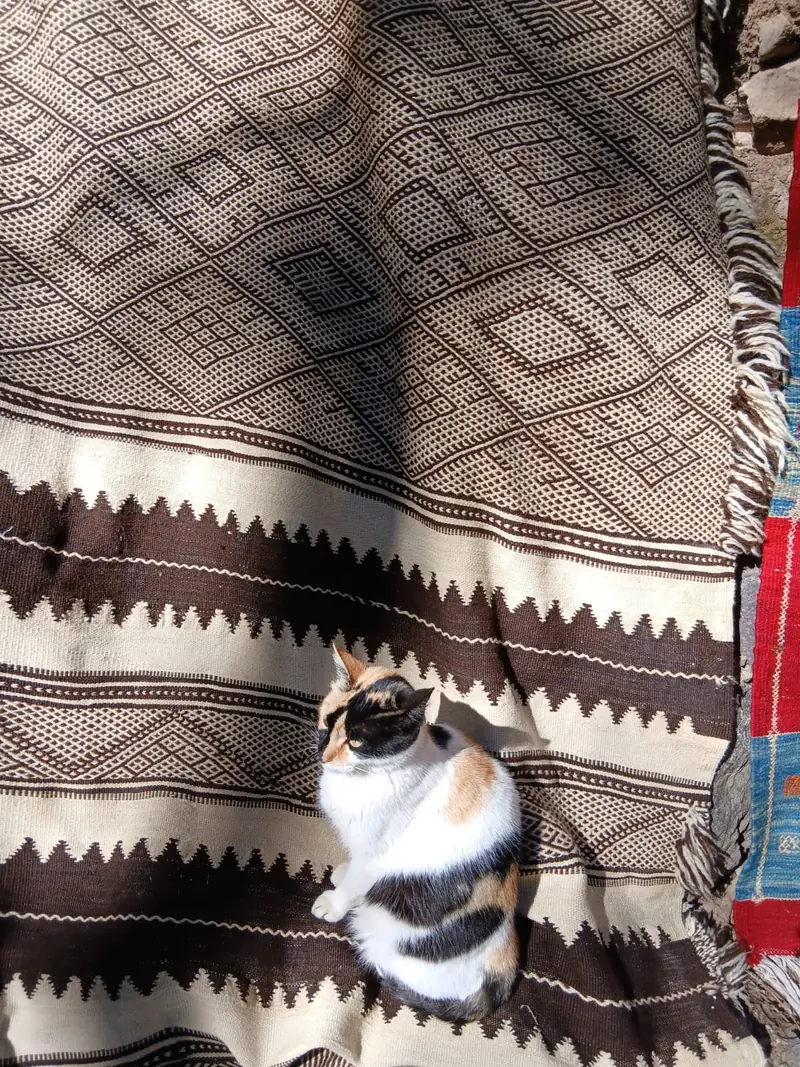
The woven border you see on our site uses two of these motifs: a zigzag edge and a chain of lozenges.
Tea for every guest
Tea is how a guest is welcomed. A guest is offered mint tea, gunpowder green tea with fresh spearmint and sugar, poured from high above the glass, and usually at least three glasses.